Disclaimer
The website contains links to external projects and content that exist independently of this initiative. We assume no liability for the content of the linked pages. These links are provided without commission, cooperation, or any institutional affiliation with the respective providers.
If an initiative should be removed from the overview, or if an initiative should be added to the list, please contact us here: guerillamuell.7e7d94@burnermail.io
Summary
- Crises can overwhelm and weaken our capacity to act.
- Hope emerges through action.
- The transformation spiral aims to set processes of action and self-efficacy in motion.
- Real utopias arise at the local level; societal initiatives can trigger political change.
- Public space belongs to everyone and should encourage collective action rather than consumption.
- The intervention shifts attention from individual consumer options towards collective possibilities for action.
- New forms of economic and social organisation are being tested within initiatives.
- Making commoning practices visible strengthens awareness of collective alternatives.
- Accessibility enables participation.
- Referencing existing initiatives makes alternative practices recognisable as real options.
- QR codes provide low-threshold entry points to engagement and participation.
We live in a time of overlapping crises whose simultaneity overwhelms many people. The climate crisis, social inequality, democratic erosion, loneliness, and geopolitical tensions, among others, create a persistent sense of emergency. Exhaustion, disorientation, frustration, anger, grief, passivity, helplessness, and withdrawal are symptoms of this overload.
At the same time, the modern narrative of progress promises that ever-increasing growth and competition will deliver societal development and prosperity. Yet, as the historian Adam Tooze (2023) notes, it is becoming increasingly clear that many contemporary crises are direct consequences of this paradigm and can no longer be resolved through incremental adjustments or improvisation alone.
For this reason, we have decided to act, not out of naive optimism for a better world, but because inaction would be the only certain form of failure. Active engagement is the pathway from learned helplessness to lived self-efficacy. Through this intervention, we aim to draw attention to organisations, community groups, and initiatives in Berlin that are already developing and practising concrete responses to multiple crises.
Active Hope as Inspiration and Conceptual Framework
Inspired by the activist and scholar Joanna Macy, we understand hope not as an optimistic expectation, but as a practice. In her concept of Active Hope and within the framework of The Work That Reconnects, Macy describes a process that helps people rediscover their interconnectedness with themselves, with others, and with the living world, thereby strengthening their capacity to act. Active hope means consciously committing to desired futures while also taking responsibility for contributing to their realisation.
Central to this approach is the recognition that difficult emotions such as fear, grief, anger, or powerlessness should not be suppressed, but acknowledged as appropriate responses to real conditions. These emotions are not seen as obstacles, but as potential starting points for transformation. Hope, in this understanding, does not precede action; it emerges through action itself.
Macy describes this process as a spiral that can lead from helplessness to self-efficacy. It begins with gratitude, which strengthens awareness of interconnectedness. The next step involves consciously acknowledging the pain for the world as an expression of that interconnectedness. This is followed by a shift in perspective: systemic thinking that enables people to "see with new eyes" and recognise relationships and structures. Ultimately, this process culminates in moving forward through concrete actions that make change tangible.
This transformation spiral forms the conceptual foundation of our structure. Based on this process-oriented understanding, we have organised our curated overview around three entry points that allow different ways of engaging with this process:
I want to learn and understand more
Educational and informational resources, contextualisation
I need emotional support and connection
Emotional support and spaces for connection and mutual support
I want to take action
Activism, engagement, and collective practice
These entry points are not intended as a linear sequence, but as interconnected pathways into active hope and collective agency. They form the conceptual framework for our intervention and guide the selection of initiatives we reference.
Why Initiatives Are Key
The sociologist Jens Beckert examines how people act economically and socially through "imagined futures". His research shows that societal change does not emerge from abstract visions, but from lived practice. When people begin to act differently, set new priorities, and experiment with alternative ways of living together, "real utopias" emerge—concrete alternatives to existing systems. Beckert emphasises that such imagined futures are central to societal dynamics, both for continuity and for transformation. Local initiatives are precisely such spaces. They embed value-based practices into everyday life and make new possibilities experientially accessible.
The economist Niko Paech complements this perspective with a crucial insight: democratic institutions such as politics, education, and media often function as stabilisers of the status quo. Political change, according to Paech, follows societal change rather than preceding it. Only when sufficient real-world laboratories have emerged, where alternative ways of living and economic organisation are established as lived experience, can broader diffusion begin. As long as alternative practices do not exist and remain invisible, they remain politically abstract. Once they are practically tested, they become recognisable as real options that can be politically adopted. In this sense, initiatives are social and economic spaces of experimentation that can serve as models and inspire imitation.
For this reason, our intervention directs attention to places where action is already taking place. By bringing initiatives together and making them accessible, we aim to provide orientation and facilitate connection to existing practices without creating new structures.
Activating Public Space
Public space is not a neutral backdrop to societal processes. Henri Lefebvre describes space as socially produced, shaped by power relations, economic interests, and everyday practices. Space does not simply exist; it is continuously created. David Harvey builds on this idea in conceptualising the "right to the city" as the collective ability not only to use urban spaces, but to shape their meanings.
In contemporary cities, public spaces are heavily structured by commercial interests. Advertising occupies sightlines, squares, and transport hubs. Jason Hickel analyses how advertising does not merely promote products; it organises attention and shapes desires. Consumption is framed as the default response to needs, even when those needs are fundamentally social. Public space thus becomes a site where consumer options are far more visible than collective possibilities for action.
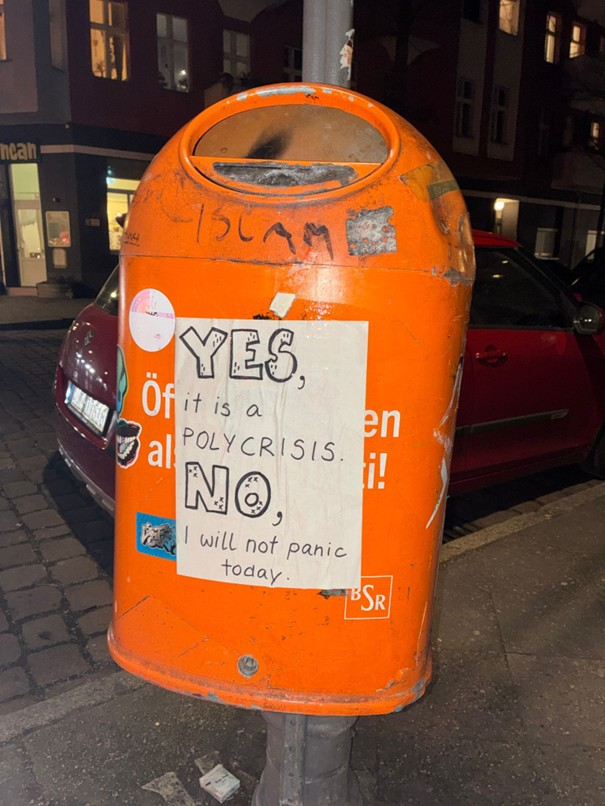
Our intervention addresses precisely this discrepancy. Rather than using conventional advertising surfaces, we work with an inconspicuous everyday object: the public bin. Bins are ubiquitous, functional, and largely overlooked. They are not perceived as sites of political communication, which makes them suitable as minimal intervention points.
Following Michel de Certeau, we understand the act of placing stickers on these objects as a tactical practice. De Certeau distinguishes between strategies, which operate from positions of institutional power, and tactics, which operate within existing structures. We do not control advertising infrastructure or urban planning. However, we can repurpose existing elements. Stickering bins is not a strategic occupation of space, but a small shift in meaning within an already commercialised environment.
Jeff Ferrell describes similar urban interventions as symbolic re-codings. Signs in public space are not fixed; they can be rewritten. An object usually associated with waste and disposal becomes, through a brief message and a QR code, a reference to existing initiatives. The bin remains a bin, but it gains an additional layer of meaning. It no longer points to a product, but to a practice.
This shift is deliberately modest. It does not claim to reorganise or reclaim public space. However, it interrupts, in small ways, the dominant logic of the attention economy. Instead of another prompt to consume, it creates a point of connection. Instead of highlighting individual consumer options, it makes collective possibilities for action visible.
In this sense, activating public space is not conceived as a spectacular gesture, but as a minimal, repeatable intervention in existing orders of meaning. It does not create new initiatives; it points to those that already exist. It does not produce new space; it alters the perception of what is already there.
Self-Efficacy Through Collective Practice
The sociologist Hartmut Rosa emphasises that collective action does not require fully shared values. What is shared emerges through acting together. In this process, self-efficacy can be experienced not as an individual achievement, but as a relational experience. For Rosa, self-efficacy is part of a resonant relationship with the world: we experience that our actions have an effect and enter into meaningful connections.
In times of societal crisis, responsibility is often individualised. When structural problems are framed as personal tasks, feelings of powerlessness can intensify. In collective practice, however, the frame shifts. Action is no longer seen as an isolated decision, but as part of a shared context.
Niko Paech adds that state institutions cannot enforce societal transformation. Change emerges where counter-practices are lived and spread. Political change follows societal experience. Participation thus becomes a prerequisite for a vibrant res publica—a "doing culture" in which new forms of economic and social organisation are tested.
From this perspective, self-efficacy is not understood as an individual goal, but as a social experience already being practised within existing initiatives.
Making Commons Visible
The commons scholar Silke Helfrich describes commons as social arrangements in which clearly defined communities collectively manage shared resources through negotiation and self-organisation. What matters is not only the shared resource itself, but the process of commoning—the ongoing practice of collectively shaping, maintaining, and governing shared goods.
Such practices are widespread, yet often remain culturally invisible. While the market is perceived as the default organisational form, collective practices are often framed as exceptions. Helfrich therefore emphasises the need to strengthen awareness of commoning patterns and to develop new language, imagery, and narratives that make collective practices recognisable.
In a city such as Berlin, numerous initiatives experiment with alternative forms of social relations, care work, and collective organisation. However, they compete in public space with commercial messages that are far more prominent.
Our intervention contributes to making existing commoning practices more visible. It does not replace initiatives or speak on their behalf. Instead, it points to projects that already exist and makes them easier to discover in everyday urban life. In doing so, it shifts the horizon of what is perceived as possible societal responses to crises.
Creating Legitimacy and Capacity to Act
The anthropologist Arturo Escobar argues that societal transformation requires two conditions: legitimacy and the capacity to act. Alternatives must be recognised as meaningful, and concrete opportunities for participation must exist.
Visibility generates legitimacy. Accessibility enables agency.
By referencing existing initiatives in public space, alternative practices become recognisable as real options. By providing low-threshold access through QR codes, passive awareness can become active participation.
Sources
Beckert, Jens (2022): Verkaufte Zukunft: Dilemmata des globalen Kapitalismus in der Klimakrise. MPIfG Discussion Paper 22/7. Köln: Max-Planck-Institut für Gesellschaftsforschung.
De Certeau, M. (2025). The Practice of Everyday Life. Contesti. Città, Territori, Progetti, 2. https://doi.org/10.36253/contest-16147
Escobar, O. and A. Bua (2025). "Democratic innovation for change: A participatory corrective to deliberative hegemony." Politics. OnlineFirst.
Ferrell, J. (1993). Crimes of style: urban graffiti and the politics of criminality / Jeff Ferrell. Garland.
Ferrell, J. (2001): Tearing Down the Streets: Adventures in Urban Anarchy.
Harvey, D. (2013). Rebel cities: from the right to the city to the urban revolution / David Harvey. (Paperback edition). Verso.
Helfrich, Silke/Bollier, David (2020): Frei, fair und lebendig – Die Macht der Commons. Bielefeld: transcript, Kapitel 1-2 (S. 9-51).
Hickel, J. (2020): Less is more: How degrowth will save the world. Random House, Introduction, Chapters 4-6.
Lefebvre, H., Edition Nautilus, Althaler, B., & Schäfer, C. (2016). Das Recht auf Stadt / Henri Lefebvre; aus dem Französischen von Birgit Althaler; mit einem Vorwort von Christoph Schäfer. (Deutsche Erstausgabe). Edition Nautilus.
Macy, Joanna (2006): Work That Reconnects Training with Joanna Macy. 16 Videos. https://vimeo.com/60907059 (Introduction) und https://vimeo.com/workthatreconnects
Macy, J. and C. Johnstone (2012). Active Hope. How to Face the Mess We're in without Going Crazy. Novato, New World Library. Introduction und Kapitel 1-4.
Paech, N. (2021). "Postwachstumsökonomie: Von der aussichtslosen Institutionen- zur Individualethik." zfwu Zeitschrift für Wirtschafts- und Unternehmensethik 22(2): 168-190.
Rosa, H. (2019). „Spirituelle Abhängigkeitserklärung". Die Idee des Mediopassiv als Ausgangspunkt einer radikalen Transformation. Große Transformation? Zur Zukunft moderner Gesellschaften. Sonderband des Berliner Journals für Soziologie. H. R. Klaus Dörre, Karina Becker, Sophie Bose, Benjamin Seyd. Berlin, Springer VS: 35-55.
Tooze, Adam (2022): Welcome to the world of the polycrisis. Financial Times, 28/10/2022.
Tooze, Adam (2025): Polycrisis – is this the sequel? Financial Times, 06/09/2025.